

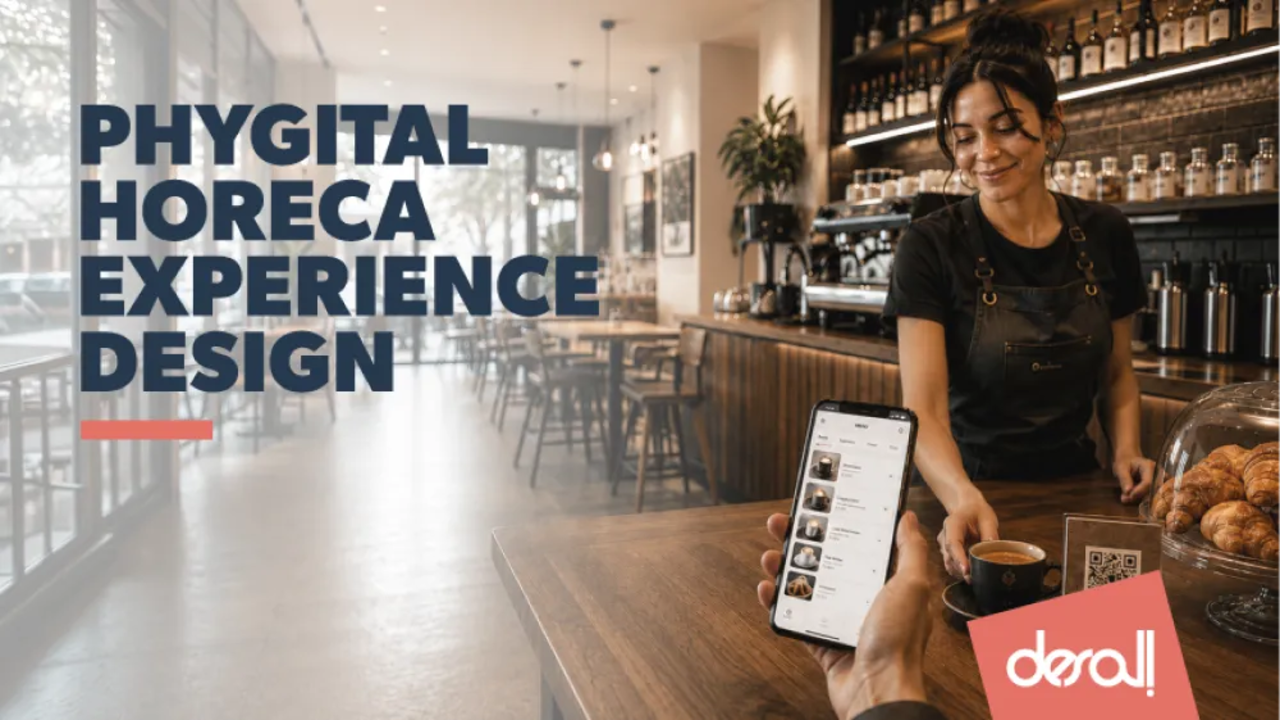
A leading international coffee producer, together with Desall, invites you to conduct research, including fieldwork, into the best phygital interaction models currently available on the market. The objective is to identify solutions capable of connecting the physical experience in HORECA venues with digital services designed to enhance the customer experience, strengthen the relationship between the brand and consumers, and generate tangible business value.
The contest is promoted by a major multinational company and leading coffee producer, which has chosen, for the time being, to keep its brand anonymous.
We are looking for phygital concepts, services and experiences capable of turning every consumption occasion in the HORECA channel into an opportunity to build a relationship between the brand and the consumer, generating value for both parties.
The term phygital refers to experiences that connect the physical dimension encountered in the venue with digital services, content and interactions, creating a coherent and continuous journey for the consumer.
Physical touchpoints include all the moments, spaces and elements that consumers encounter in the venue, such as the menu, table, counter, packaging, communication materials, payment stage, etc.
Digital touchpoints include the interfaces and channels through which consumers can interact with the brand and access content or services, such as apps, web platforms, digital menus, payment systems, loyalty programs, interactive devices, notifications and personalized communications, etc.
The transition from the physical to the digital dimension may be activated through triggers and enabling technologies, such as QR codes, NFC, beacons, sensors and interactive devices, etc.
The required deliverable must include a field research phase, aimed at directly observing and analyzing consumer behavior, the touchpoints available in venues, and the ways in which the physical and digital experiences interact.
The research must identify innovative ways to increase the brand’s presence throughout the customer journey, influence consumer decision-making, facilitate data collection and the development of direct relationships, and enable integrated digital experiences that continue beyond the point of sale.
Particular attention must be paid to scalable service and business models that can be replicated in different contexts and make the value generated measurable, rather than focusing exclusively on individual technology implementations.
You are required to photographically document the entire customer journey within the business premises, including, by way of example, images of the entrance, main environment, physical touchpoints (e.g. printed menu), activation triggers (e.g. QR code), digital touchpoints (e.g. a dedicated loyalty program app), and any other element relevant to the user experience.
Present your proposal using the images that can be uploaded to the platform and the .doc or .pdf file included in the Material files. .zip archive.
Guidelines
To conduct the research correctly, please consider the following guidelines:
Project type
You are invited to research and analyze digital services, platforms, phygital ecosystems, engagement programs, omnichannel experiences and relationship models capable of connecting the physical in-store experience with digital services and interactions.
The required activity includes a field research phase and an analysis of international benchmarks in the fastest-growing segments, aimed at identifying replicable models already available on the market. Based on the evidence collected, you shall then define and present an original phygital concept applicable to the coffee sector.
During the research phase, the following observation contexts must be included:
Independent HORECA businesses
– Bars (coffee shops)
– Bakery cafés
– Lifestyle & immersive dining experiences
HORECA retail chains
– Bars (coffee shops)
– Bakery cafés
– Lifestyle & immersive dining experiences
Non-HORECA businesses
For a detailed overview of the deliverables required for participation, please carefully read the “Required materials” section below.
During the evaluation phase, particular importance will be given to field research supported by adequate photographic documentation.
Analysis criteria
The research must focus on models that fit naturally into the coffee consumption experience, without introducing unnecessary steps or increasing interaction complexity. The analysis must consider the different moments that characterize this experience: from product selection and ordering, through preparation and consumption, to occasions following the visit to the venue.
The identified models must offer consumers a clearly perceivable benefit, both during and after consumption. The digital component must enrich the physical dimension of the experience by supporting greater product knowledge, service personalization, discovery of the offering, or access to additional content and services.
Particular attention must be paid to the ability of the analyzed models to accompany consumers through the different stages of the customer journey, encouraging continuous engagement, loyalty and the development of a direct relationship with the brand.
The identified models must contribute to the following objectives:
– increase the brand’s presence, visibility and relevance throughout the customer journey associated with coffee consumption;
– intercept the consumer’s decision-making moment and encourage the selection of premium products, new preparations or consumption occasions, increasing conversion and purchase frequency;
– facilitate the collection of data and qualified contacts and the development of direct relationships with consumers, using transparent and sustainable methods;
– extend the relationship beyond the point of sale through integrated and personalized digital experiences, active across multiple channels and at different consumption moments;
Scalability
The research must prioritize service and business models that are replicable and easily adaptable to different commercial contexts, markets and formats.
Analyses that highlight the economic sustainability of the identified models will be evaluated positively, together with their adaptability to different HORECA channel formats (such as bars, coffee shops, bakery cafés and restaurants), different international markets, and the specific characteristics of individual points of sale.
Submission materials
Present your proposal using the images that can be uploaded to the platform and the .doc or .pdf file included in the Material files. .zip archive.
The submission must include:
1 benchmark of a phygital experience implemented in an independent HORECA business belonging to one or more of the following segments: bars and coffee shops, bakery cafés, lifestyle and immersive dining experiences;
1 benchmark of a phygital experience implemented in a HORECA retail chain belonging to one or more of the following segments: bars and coffee shops, bakery cafés, lifestyle and immersive dining experiences;
1 benchmark of a phygital experience implemented in a context outside the HORECA sector;
1 original phygital experience concept, developed by you and specifically designed for the coffee sector.
For each of the four deliverables, the benchmark sheet must also be completed with the following information:
– Implementation context
– Call-to-action description
– Customer journey
– Type of physical touchpoint
– Type of digital touchpoint
– Type of trigger
– Description of the activated service
– Menu presentation method
– Characteristics of the printed menu (format, number of pages, structure, content organization, etc.)
– Data collection method
– Technologies used
– Benefits for the end customer
– Business value
– Replicability
– Key insights
– Other notes
You are required to photographically document the entire customer journey within the business premises, including, by way of example, images of the entrance, main environment, physical touchpoints (e.g. printed menu), activation triggers (e.g. QR code), digital touchpoints (e.g. a dedicated loyalty program app), and any other element relevant to the user experience.
The images displayed in the gallery (maximum 5) must have a 4:3 aspect ratio; accepted file formats: .jpg, .gif or .png; color mode: RGB; maximum size per file: 1 MB.
During the project upload phase, you are invited to upload a .zip archive in the dedicated field containing the .doc or .pdf file and all images related to the research. Maximum .zip file size: 100 MB.
Judging criteria
When evaluating the submissions, the Sponsor will consider the following criteria:
Degree of innovation 5/5
Functionality 5/5
Aesthetic quality 3/5
Technical feasibility 3/5
Economic feasibility 3/5
Awards:-
1° Award: €1000
2° Award: €1000
3° Award: €1000
4° Award: €1000
5° Award: €1000
Extra Award (option right fee)
€1000
For the duration of the option right, the Sponsor may acquire a licence for the commercial exploitation of any non-winning project by paying the participant a fee of €1000. The selection of the winner will be made at the Sponsor’s sole discretion.
Deadline:- 29-10-2026