

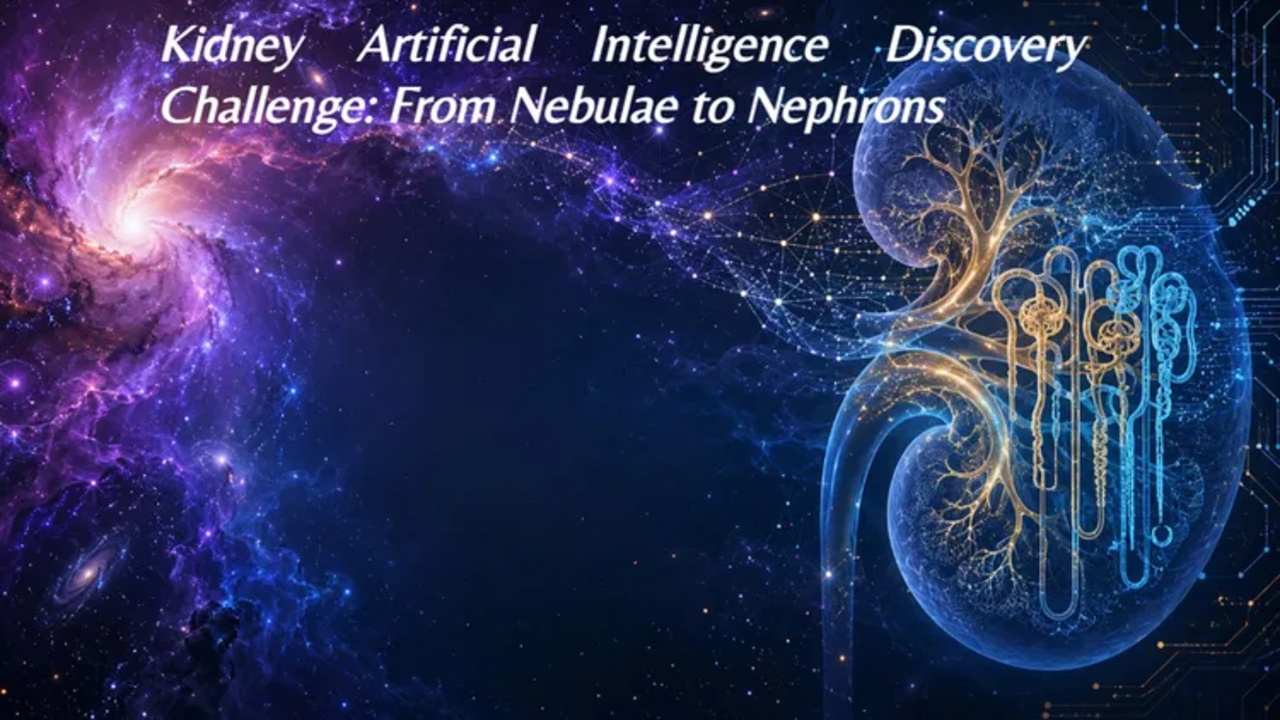
The subject of this challenge is the application of artificial intelligence, machine learning, computer vision, and related computational methods to identify previously unrecognized or under-characterized patterns in data generated by the Kidney Precision Medicine Project, or KPMP, a project supported by the NIDDK. The challenge, titled “Kidney Artificial Intelligence Discovery Challenge: From Nebulae to Nephrons,” seeks to advance a new discovery paradigm for kidney disease research by adapting anomaly-detection approaches used in astronomy and other data-intensive fields to the analysis of kidney tissue images, multi-omics data, spatial data, and associated clinical information.
Kidney disease affects approximately 35.5 million people in the United States, yet important gaps remain in understanding disease heterogeneity, mechanisms of progression, treatment response, and opportunities for earlier intervention. The National Institute of Diabetes and Digestive and Kidney Diseases (NIDDK) established the Kidney Precision Medicine Project (KPMP), a multi-site research initiative focused on improving our understanding of kidney disease at the molecular and cellular levels.
KPMP’s primary goal is to collect and comprehensively analyze human kidney biopsy tissue from individuals with chronic kidney disease (CKD) or acute kidney injury (AKI). These data are used to develop the Kidney Tissue Atlas, a detailed resource that maps kidney cell types, tissue structures, disease pathways, and potential therapeutic targets.
The desired solutions are conceptual, methodological, and collaborative approaches that support anomaly-based discovery in KPMP data. The participants will focus on image-based feature discovery by identifying novel, patterns, objects, or anomalies in kidney pathology images. Participants will detect anomalies, demonstrate how computational or other methods can reveal previously unrecognized structures or signals, and provide supporting evidence for their findings. Participants may also explore how detected features could support patient stratification, including approaches to group or reclassify patients based on image-derived anomalies in combination with clinical parameters or other KPMP data. Assigning molecular mechanisms to newly identified features is a longer-term goal and may be addressed through a future challenge. The challenge is expected to emphasize rigorous human-AI collaboration, with pathologists, nephrologists, and other kidney domain experts validating and interpreting computationally identified anomalies.
The objective of the challenge is not merely to classify known disease states, but to stimulate new approaches for discovering patterns in imaging data that may improve understanding of kidney disease mechanisms and inform future precision medicine efforts. Potential areas of focus may include novel tissue features, unusual cellular or structural arrangements, spatially localized disease signatures, patterns associated with progression risk, markers of treatment response, or multi-modal signatures that link morphology to molecular pathways and clinical outcomes.
The intended effect of the challenge is to catalyze cross-disciplinary collaboration that may include astronomers, AI researchers, computer vision experts, pathologists, nephrologists, and multi-omics scientists. In the near term, the Challenge is expected to produce a cross-disciplinary network of investigators, a catalog of priority anomaly-detection targets in KPMP data, conceptual analytic pipelines, and a strategic white paper or roadmap. The challenge winners may also be invited to serve as co-authors or contributors to an anticipated publication arising from this effort. In the medium term, the winning solutions may be used to further the development of technical specifications, data preparation and governance approaches, working groups, and future proposals for computational infrastructure and validation studies. In the long term, the Challenge is intended to incentivize the development, testing, and delivery of solutions that can enable future discovery of novel disease subtypes, progression markers, therapeutic response signatures, and validated tools that may ultimately improve patient care.
Ultimately, the challenge aims to accelerate progress toward precision nephrology by helping researchers identify patient subgroups and patterns that can inform new treatment options, improve treatment selection, enhance patient outcomes, and support more efficient use of public resources for individuals with acute or chronic kidney disease.
Awards:- $100,000
Deadline:- 30-04-2027