

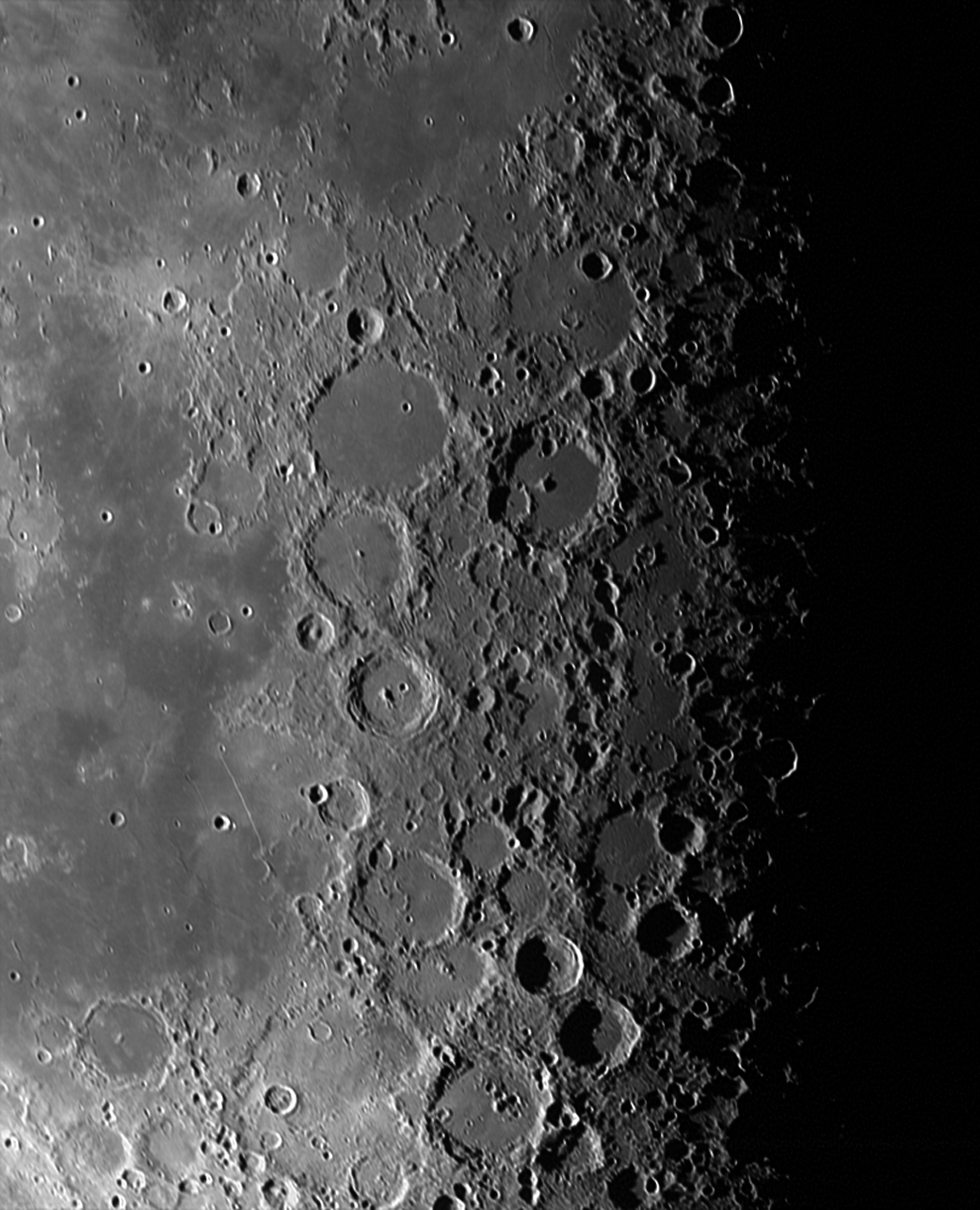
Crater rims are vital landmarks for planetary science and navigation. Yet detecting them in real imagery is tough, with shadows, lighting shifts, and broken edges obscuring their shape. This project invites you to develop methods that can reliably fit ellipses to crater rims that are visible in orbital lunar imagery, helping advance future space exploration.
In this task you will work with grayscale PNG image files. These are synthetic images showing the surface of the Moon viewed from different locations, altitudes, orientations and lighting conditions. Data is organized into a folder structure representing different altitudes and longitudes. For each altitude / longitude combination there are the raw view images, and also there is a truth folder that contains
- mask images that represent the hand labeled true crater ellipses (
..._mask.png), - images that overlay the masks on the views (
..._truth.png, - a
detections.csvfile that lists parameters of all the visible ellipses on every image in the given folder.
Note that the ground truth data in this contest does not contain all ellipses present in the detections.csv files, see Crater filtering later. Similarly, the mask and overlay images also show more ellipses than those present in the ground truth data.
Crater filtering
Those craters that satisfy at least one of the following conditions are filtered out from the ground truth and should not be detected by your algorithm.
- Too small craters: if the semi-minor axis is less than 40 pixels long.
- Too large craters: if w + h >= 0.6*S, where w and h are the width and height of the crater’s bounding rectangle, S is the smaller of the image’s width and height.
- Not fully visible: if the crater’s bounding rectangle extends beyond the image’s frame (even by a fraction of a pixel).
Downloads
Input files are available for download from the nasa-craters-public AWS bucket. A separate guide is available that details the process of obtaining the data.
The following files are available for download.
train.tar(19.6 GB). The full training data set.train-sample.tar(234 MB) A small subset of the training data. Use this if you want to get familiar with the data without having to download the full set.train-gt.csvcontains the training ground truth in a single file, in the same format as is required for output files in this contest. See the details of its format in the Output File section. Note that this file does not contain some of the columns of thedetection.csvfiles (e.g.detectionConfidence) that are not needed for the contest.test.tar(3.3 GB). The provisional testing data set. Your submissions must contain crater detections from this data set.sample-submission.zip. A sample submission package to illustrate the required submission format.scorer.pyis an offline scoring utility that you can use to calculate the detection quality. Its source code also serves as a detailed description of the scoring algorithm.data_combiner.pyis an utility that can be used to create the ground truth CSV file from a subset of training files. It traverses a folder structure containing training data and combines the content of thedetection.csvfiles, taking care of crater filtering and removing the unneeded columns.
Awards:- $55,000 in total prizes
Deadline:- 19-01-2026