


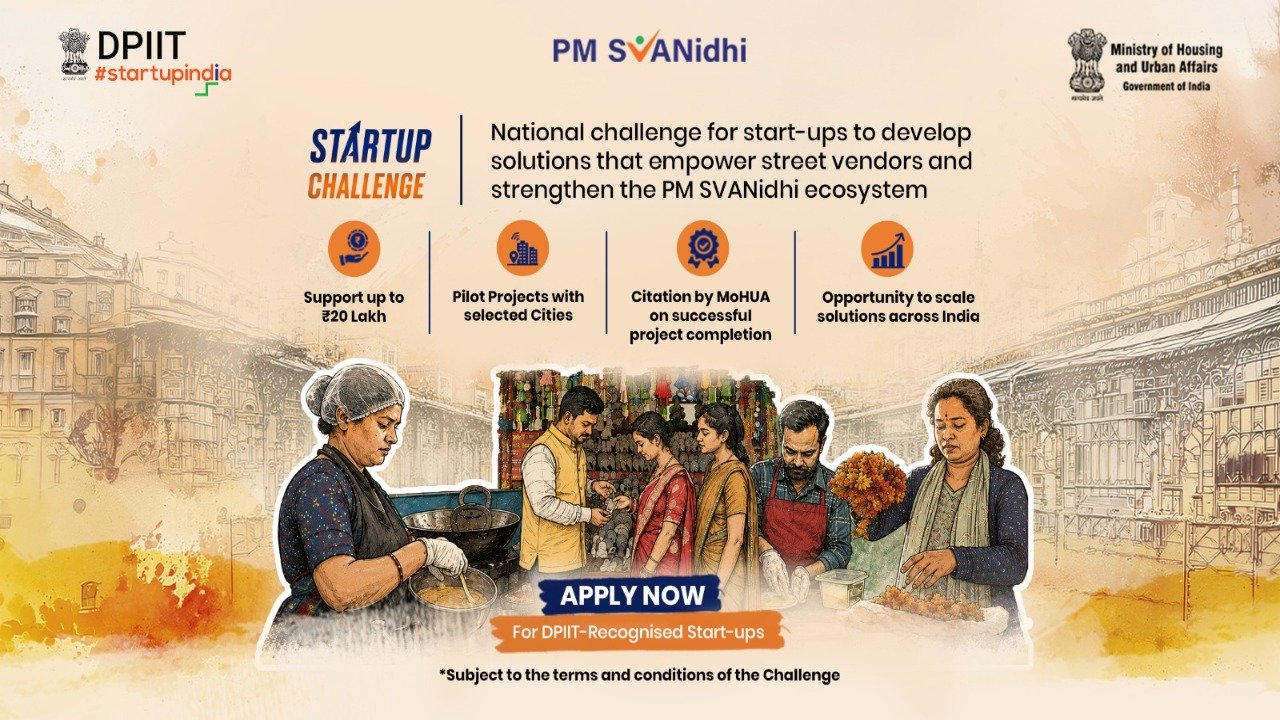
The PM SVANidhi Startup Challenge, launched in collaboration with Startup India and aims to harness the innovation potential of DPIIT-recognized startups to develop scalable solutions that empower and strengthen the livelihood of street vendors . The Challenge seeks innovative solutions across key focus areas, including vendor identification and outreach, entrepreneurship development, bookkeeping and financial management, eco-friendly packaging, climate-resilient vending infrastructure, and market linkages. Selected startups will receive financial support of up to ₹20 lakh, opportunities to pilot their solutions in selected cities, and a pathway to scale successful innovations across the country.
Entrepreneurship development and handholding support for street vendors
A large proportion of street vendors operate in the informal sector with limited access to structured business training and capacity-building opportunities.
• Vendors often lack basic entrepreneurial skills such as pricing, customer engagement, inventory planning, and business expansion strategies.
• Limited digital literacy restricts adoption of digital payments, online platforms and reducing growth potential.
• Street vendors face challenges in accessing formal markets, institutional buyers, and organized supply chains, leading to low and unstable incomes.
• There is a need for integrated, continuous handholding systems that combine training, digital enablement, and market linkages.
Expectation from Solution – Development of scalable models for business training, digital onboarding, and market integration tailored to street vendors
Eco-Friendly Packaging
Street food vendors largely depend on single-use plastic and non-biodegradable materials due to their low cost and easy availability.
• Awareness regarding environmental impact and sustainable alternatives remains limited among vendors.
• Existing eco-friendly packaging options are often expensive, inaccessible for small-scale vending operations, vendors lack viable, affordable alternatives.
Expectation from Solution- Development of low-cost, durable, and biodegradable packaging solutions suited to street food ecosystems.
Outreach and Vendor Identification
• A significant number of street vendors, particularly in Tier-2 and Tier-3 cities, remain unidentified and outside the ambit of formal schemes like PM SVANidhi.
• Lack of awareness and trust barriers prevent vendors from registering or availing scheme benefits.
• Traditional outreach methods are resource-intensive and fail to capture migrant and mobile vendors.
• Limited use of technology in vendor identification and onboarding slows down inclusion efforts.
Expectation from Solution -Innovative, tech-enabled solutions for accurate identification, outreach, and onboarding of street vendors at scale.
Bookkeeping and Financial Management
• Most street vendors maintain little to no formal records of daily sales, expenses, or inventory.
• Absence of financial records limits access to formal credit and financial services.
• Existing digital bookkeeping tools are often too complex or not tailored to low-literacy users.
• Vendors struggle with cash flow management, leading to inefficiencies and income instability.
• Lack of awareness and training in financial management practices further exacerbates the issue.
Expectation from Solution -Simple, intuitive, and mobile-based tools for bookkeeping and financial tracking designed for ease of use.
PM SVANidhi Credit Card Usage and Repayment Support
• Adoption of PM SVANidhi credit cards among street vendors remains limited due to low awareness and apprehension towards formal credit systems.
• Vendors often lack understanding of credit cycles, billing, and repayment processes.
• Irregular income patterns make it difficult for vendors to manage timely repayments.
• Absence of structured reminder systems leads to missed payments and penalties.
• Poor repayment behaviour can negatively impact credit scores, limiting future financial inclusion.
Expectation from Solution -Development of user-friendly tools and outreach models to improve credit usage awareness and repayment discipline.
Climate-Resistant and Ergonomic Vending Solutions
• Street vendors operate in harsh outdoor conditions, facing prolonged exposure to heat, rain, pollution, and physical strain.
• Existing vending carts are often poorly designed, lacking ergonomic considerations such as appropriate height, mobility, and storage efficiency.
• Limited protection from weather conditions affects both vendor health and food safety.
• Current vending setups are not adaptable to varying climatic conditions, reducing operational efficiency and comfort.
• Durable and modular vending solutions are scarce, and available options are often expensive or not customizable.
Expectation from Solution – Design and development of affordable, ergonomic, and climate-resilient vending infrastructure to improve vendor productivity and well-being.
Awards:- Up to Rs 20lakhs per startup, released in 3 tranches based on the milestones achieved.
Deadline:- 15-09-2026